

The Gardner School is committed to doing what’s best for children, so we integrate strategies from a variety of traditions to provide a truly unique educational experience. Children at the Gardner School find caring teachers and daily activities that help them develop and grow. We’ve incorporated basic principles of Montessori into our curriculum in the following ways:
Our Approach to Preschoolers (ages 3-6)
Practical Life
Montessori Learning Goal: Focus on self-care, care of others, and care of the environment. Children learn daily life skills and practical life activities. These activities promote independence, kindness, concentration, and coordination.
Practical Life Skills at The Gardner School: Social-Emotional skill development is a key component of our learning curriculum and daily lesson plan. Our Making Good Choices curriculum encourages children to self-reflect on their decision-making process. We provide scaffolded strategies for building friendships and strengthening social skills. Daily life skills, independence, self-care, and care of others are included in daily learning activities.
Sensory Awareness
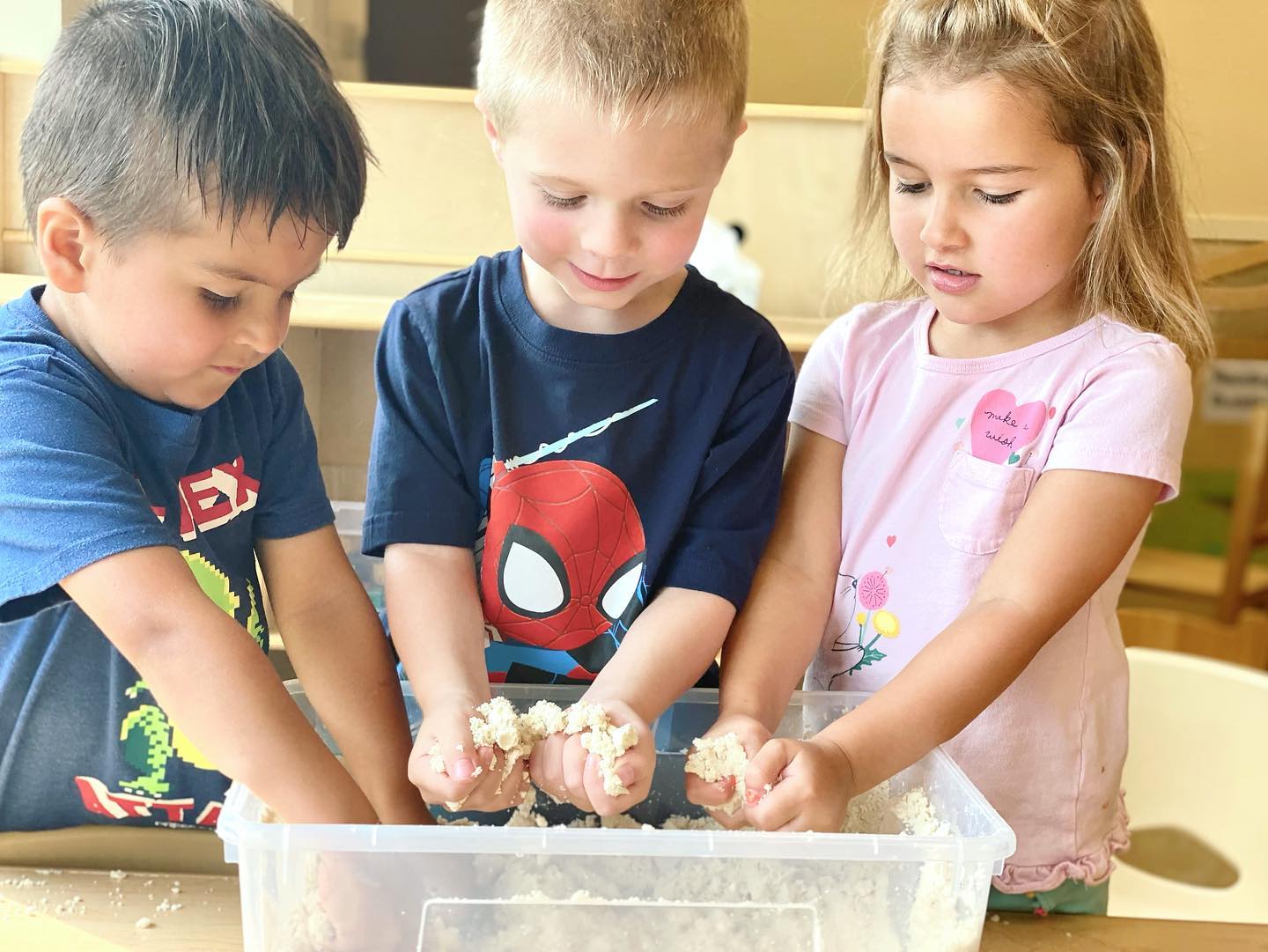
Montessori Learning Goal: Refine the senses of sight, sound, touch, taste, and smell. Be able to clarify, sort, and discriminate between objects.
Sensory Awareness at The Gardner School: Our preschool WOW Curriculum provides hands-on science learning activities that engage the senses. Students are encouraged to clarify, sort, and discriminate between objects to interpret their sensory impressions.
Linguistic Development
Montessori Learning Goal: Introduce preschoolers to letter recognition, phonics, simple word structures, vowels and consonants, and the early stages of writing and reading.
Linguistic Development at The Gardner School: We begin building language and literacy skills with our preschoolers through our WOW Curriculum, which promotes letter recognition, phonics, simple word structures, vowels, and consonants. Our handwriting curriculum in Learning Without Tears promotes the early stages of writing. Students have individualized handwriting practice to help develop fine motor skills and introduce basic letter shapes. Frequent read-alouds are a primary feature of our classrooms.
Mathematics
Montessori Learning Goal: Develop an understanding of abstract mathematical concepts through hands-on experiences. Students learn to identify and quantify numerals, count and sequence numbers, add and subtract, identify patterns and learn about number systems.
Number Sense Development at The Gardner School: Our learning curriculums for our preschool classrooms include mathematics as a daily learning activity. Math concepts are introduced using hands-on learning tools and individualized-small group learning. Students are prepared for assessments that include learning to identify and quantify numerals, counting and sequencing numbers, and identifying patterns and number systems. All students are encouraged to learn at their own pace. Teachers use visual aids and physical learning tools to aid in comprehension.
Culture, Arts, Geography, Science, Environment, National Culture, Music & History
Montessori Learning Goal: Children learn about their community and the world and are encouraged to respect diversity and all living things.
Cultural Studies at The Gardner School: The “Discovering Our World” curriculum and our WOW curriculum in Science and Social Studies promote learning about the arts, geography, science, environment, community, and the world. Visual aids are included such as digital computer access, photo cards, maps, and nature activities. Our Music and Movement activities introduce diversity through music, rhythm, and dances from the U.S. and abroad.
Our Carefully Designed Learning Environments For All Students
Montessori education focuses on creating an intentionally prepared learning space where everything has a purpose and a place. We echo this principle through our classroom environment design, which is separated into separate learning centers, including areas with objects for imaginative play, hard and soft building materials, art supplies, cozy reading spaces, and sensory tables. Children are encouraged to follow their interests during open exploration time.
The Gardner School integrates research-backed activities for child development to support the growth of our students. To learn why parents choose The Gardner School as a partner to help their children grow and learn, contact us to learn more or to schedule a virtual tour.